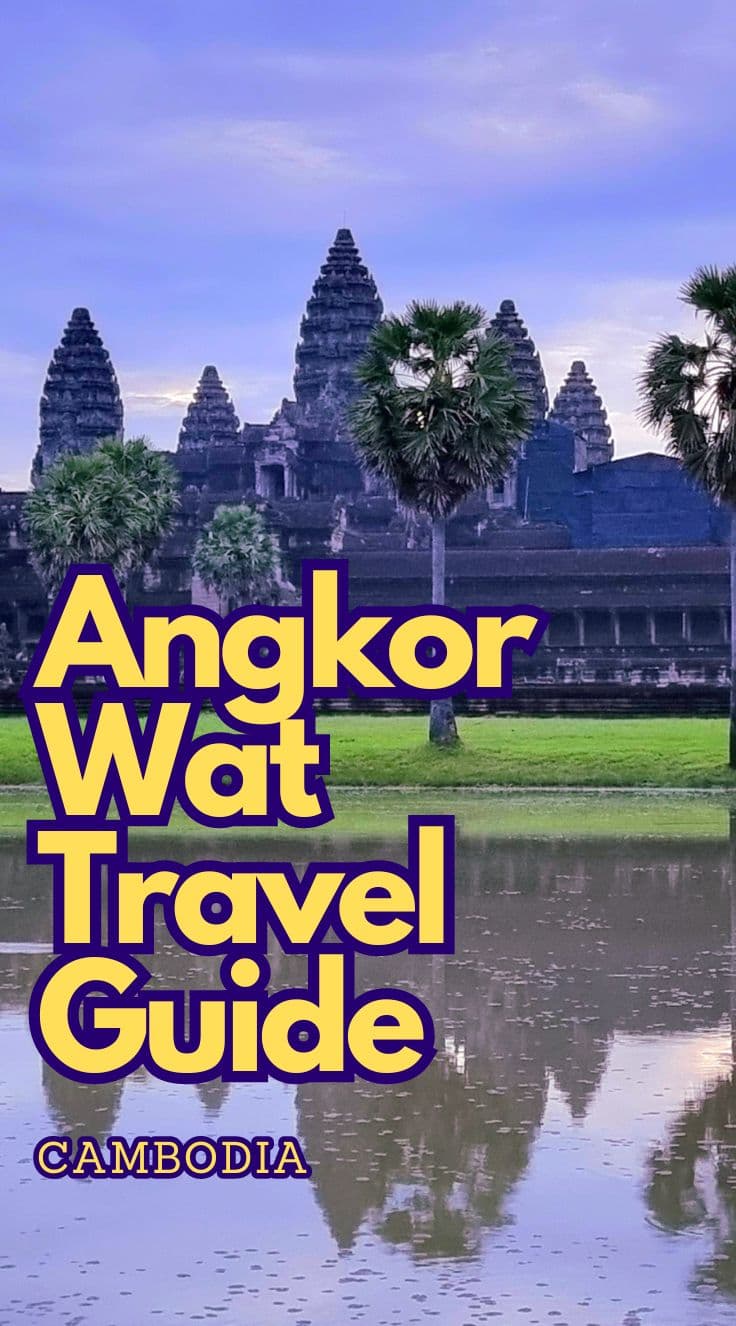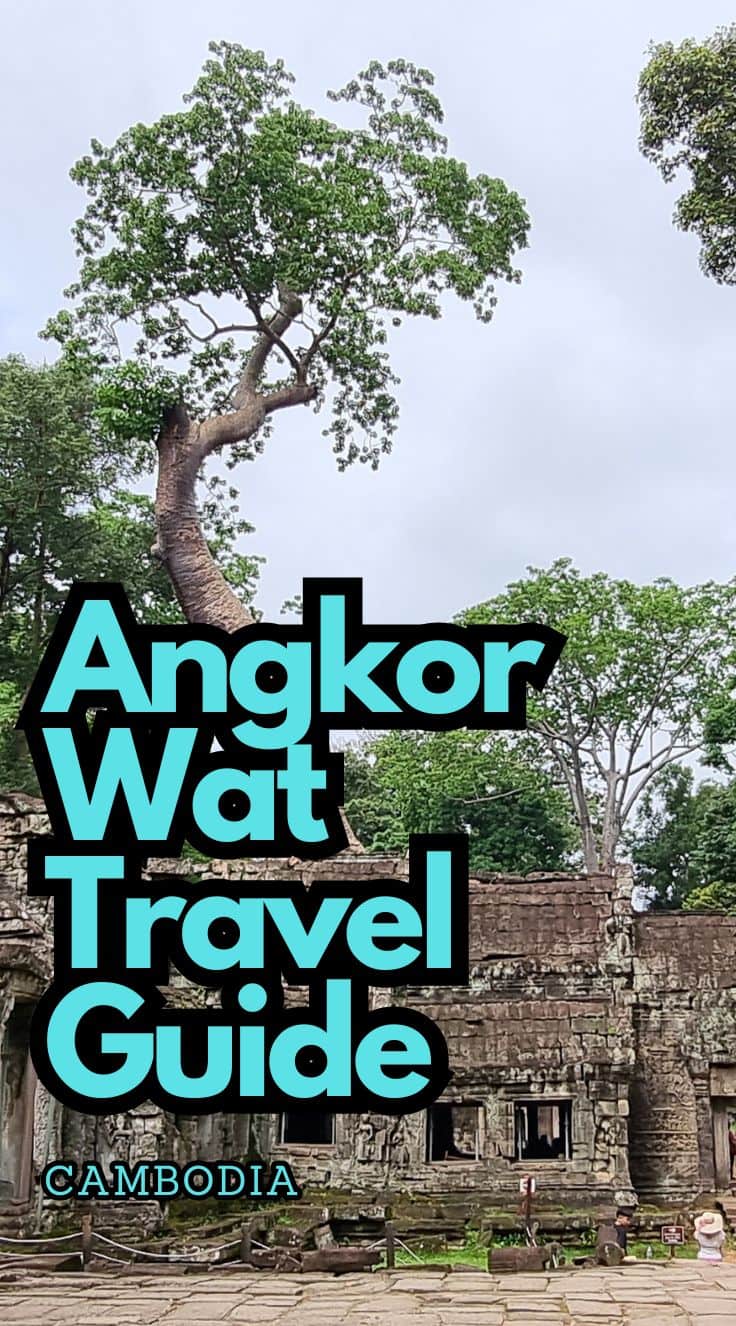
Do you have an Angkor Wat sunrise on your bucket list? Our Angkor Wat guide gives plenty of information to help you plan the most memorable Angkor Wat experience.
When you think of Angkor Wat images of a long-forgotten civilisation spring to mind. These lofty towers are showered with colour as sunrise and sunset proclaim another day to be added to its already illustrious history.
Angkor Wat is the most recognised temple in the Angkor Archaeological Park, but there are lots more to be seen on a visit to this awe-inspiring UNESCO World Heritage Site.
Entry costs US$37 for one day or US$62 for three days, the park opens at 5am for sunrise, Siem Reap is the base city, and most visitors need two to three days.
Angkor Wat is the headline act, but two temples nearby deserve just as much of your time. Ta Prohm, made famous by the Lara Croft: Tomb Raider movie, is slowly being swallowed by giant tree roots, while Bayon is unforgettable for its hauntingly beautiful stone faces.
It is easy to imagine early explorers gasping in wonder at the sight of these ancient temples, hidden and preserved in time by lush vegetation and the thickly entwined roots of the trees that dominate the landscape.
- Where is Angkor Wat
- Angkor Wat Tickets and Prices (2026)
- Opening Hours and the Best Time to Visit
- Sunrise at Angkor Wat
- Angkor Wat Temple Complex
- Angkor Thom South Gate – Tonle Om Gate
- Bayon Temple
- Ta Prohm
- Banteay Kdei Temple
- How Many Days Do You Need at Angkor Wat?
- Angkor Wat Dress Code
- How to Get to Angkor Wat
- Getting to Angkor Wat from Australia
- Is a Visa Needed for Cambodia?
- Angkor Wat Tour Options
- Angkor Wat for the Independent Traveller
- Angkor Wat FAQ
- Last Words on Angkor Wat Guide Cambodia

Where is Angkor Wat
Angkor Wat is located outside the city of Siem Reap in the Siem Reap Province of Cambodia. Phnom Penh, the capital of Cambodia is 323 kilometres away from Angkor Wat.
The nearest city is Siem Reap, which is where you’ll base yourself for a visit. The main park entrance is only about a 15 minute tuk tuk ride from the city centre, so you can be back at your hotel pool by lunchtime if the heat gets the better of you.
Angkor Wat Tickets and Prices (2026)
Entry to Angkor Wat is via the Angkor Pass, which covers not just the main temple but more than 90 temples across the entire Angkor Archaeological Park, including Bayon, Ta Prohm and Banteay Srei. There are three options:
- 1 day pass: US$37 (around A$57)
- 3 day pass: US$62 (around A$95), valid for any three days within a 10 day window
- 7 day pass: US$72 (around A$110), valid for any seven days within a 30 day window
Children under 12 enter free, but you’ll need their passport as proof of age, and it can be checked again at temple entrances so keep it with you.
For most first time visitors the 3 day pass is the smart buy. Three separate day passes would cost US$111, and one day at the temples is genuinely rushed. We’d suggest even travellers on a tight schedule consider it, because the pass days don’t need to be consecutive. If you fall in love with the place, and plenty do, you’ve got the flexibility to go back.
Where to buy your Angkor Pass
Buy directly from Angkor Enterprise, the official Cambodian government ticket operator, either online at angkorenterprise.gov.kh or at the ticket office on Road 60, about 4km from the Siem Reap city centre.
We recommend buying online before you arrive. You’ll get a QR code that works offline from your phone, and you’ll skip the ticket office queue, which matters more than you might think.
If you’re heading out for sunrise, that queue can be 50 people deep before 5am in peak season, and losing 45 minutes in the dark is a rough start to a big day.
One warning: only buy from the official Angkor Enterprise website. There are fake ticket sites out there charging inflated prices, and a dodgy ticket is not a problem you want to discover at a temple gate at 5am.
Every pass includes your photo, taken at the counter or uploaded during online purchase, and passes are strictly non-transferable. Guards do check.
A tip worth knowing: the free sunset
If you buy your pass at the ticket office after 4:45pm, you’re allowed into the park that same evening before your pass days officially start. Head to Phnom Bakheng or Pre Rup for sunset and you’ve effectively scored an extra half day of temple time for free.
The fine print
A couple of things your Angkor Pass doesn’t cover. Phnom Kulen (US$20) and the Koh Ker temple complex (US$15) require separate tickets. And here’s a detail we like: US$2 from every pass sold goes to the Kantha Bopha Children’s Hospital in Siem Reap, which provides free care for Cambodian kids.
Prices checked July 2026 via Angkor Enterprise.

Opening Hours and the Best Time to Visit
Angkor Wat itself opens from 5am to 6pm daily, with the early start allowing for sunrise viewing. Most other temples in the park open from 6am, so plan Angkor Wat first if sunrise is on your list. Hours can shift slightly with the seasons, so treat closing times as a guide rather than a promise.
As for when to go, there’s no perfect month, just trade-offs.
November to February is the dry, cooler season and the most comfortable time to visit. It’s also peak season, so expect the biggest crowds at sunrise and the main temples, and book accommodation ahead.
March to May is brutally hot, with April regularly pushing past 35 degrees. If you visit then, do what the locals do: temples at dawn, pool or air conditioning through the middle of the day, back out late afternoon.
June to October is the wet season, and it’s more visitable than its reputation suggests. We visited in September and it rained heavy for a couple of short periods and then cleared so it didn’t bother us that much. Get your temple time in during the morning and you’ll rarely be caught out.
The payoff is real: the moats are full, the jungle around the temples is at its greenest, and the sunrise crowds are noticeably thinner than in peak season. The humidity is hard work though, so carry more water than you think you need.

Sunrise at Angkor Wat
If sunrise is on your list, and it should be, here’s how the morning actually runs. Leave Siem Reap by 4:30am, which your tuk tuk driver or tour operator will suggest anyway, and aim to be inside the grounds by 5 to 5:15am.

The classic reflection photo is taken from the northern reflecting pool, on your left as you face the temple, and the best spots at the water’s edge go early. Bring a torch or use your phone light for the walk in, because the causeway is unlit and uneven in the dark.
And yes, you’ll be sharing the moment with hundreds of others, but as we found on both visits, there is plenty of Angkor Wat to go around.

Angkor Wat Temple Complex
After sunrise it is time to cross the causeway that marks the entrance to the main temple of Angkor Wat. This impressive temple was built by King Suryavarman II in the 12th Century as a Hindu temple dedicated to Vishnu.
There are three stories to the Angkor Wat temple and as you climb each level the architectural majesty of the complex unfolds before you.
Stone doorways lead to long open-air corridors that display wall carvings of the military parade of Suryavarman II. These images depict the ranks of court life, religious rituals, and battle scenes.

Shaded walkways surround a collection of deep waterless pools which were once used for religious purification. The walls are decorated with beautifully carved Apsara dancers, their movements forever captured in stone.
Under King Jayavarman VII, Angkor Wat was converted to a Buddhist temple, making the complex a site of pilgrimage for both Hindu’s and Buddhists.

Angkor Thom South Gate – Tonle Om Gate
Angkor Thom South Gate is one of the five gates which lead into Angkor Thom, the capital city of the Khmer Empire under King Jayavarman VII.
As you cross over the moat you will find two columns of statues representing the struggle between good and evil. These statues lead to a highly ornate gate flanked by elephants and topped with an impressive tower featuring a four-sided face, reminiscent of the faces seen at Bayon Temple.

Bayon Temple
Bayon is one of the most beautiful temples in the Angkor Archaeological Park. Bayon was built between the 12th and 13th Century as the state temple of King Jayavarman VII and is the symbolic centre of the universe and empire.
Walking toward Bayon you will be mesmerised by the towers of giant faces that look down upon you. Gazing out in each direction, you feel compelled to get nearer and after climbing many levels you are close enough to almost touch these tranquil faces.
Each face radiates a serene beauty, a stark contrast to the bloody battle scenes that line the walls below.

Ta Prohm
Also built by King Jayavarman VII, Ta Prohm temple or the Tomb Raider Temple as it is also known, acquired worldwide fame when it was used as a location for the Lara Croft: Tomb Raider movie.
This temple conjures up visions of intrepid adventurers slashing their way through the jungle. Imagine the wonder they must have felt when they discover these magnificent ruins.
Mother nature has staked her claim on this vast temple taking back what is hers. Ta Prohm temple is surrounded by thick forest. Ancient trees stretch high into the sky, their stocky roots tangled amidst the temple ruins.
Intricately carved images of life at Ta Prohm peak out between the roots, reminding us of the architectural and cultural sophistication of the Khmer Empire.

Banteay Kdei Temple
Banteay Kdei is another temple constructed by the “Great Builder” King Jayavarman VII. Banteay Kdei Temple is also well shaded by tall trees and is much like Ta Prohm in style.
When you visit you will find that Banteay Kdei is less crowded than the more popular Bayon and Ta Prohm temples.

The temple is divided into a series of maze-like chambers, living up to its name, “The Citadel of Chambers.” As you enter these cool rooms you will find decorative wall carvings of Apsara dancers and a small Buddhist shrine.
Together, these temples make up the heart of what’s known as the small circuit, which is the route most first time visitors follow. Here’s how to fit it all together.
How Many Days Do You Need at Angkor Wat?
One day is doable but it’s a big day. Start with sunrise at Angkor Wat and explore the main temple before the heat builds, then head to Angkor Thom and Bayon mid morning. Take a proper break over the middle of the day when the temperature peaks and the tour groups are thickest, then finish with Ta Prohm and Banteay Kdei in the afternoon. You’ll see the highlights, but you’ll feel it by dinner.
Three days is our recommendation, and the pricing backs it up since the 3 day pass costs only US$25 more than a single day. Spread the small circuit above over a gentler first day, use day two for the grand circuit taking in Preah Khan, Neak Pean and Ta Som, with Pre Rup a popular spot for sunset.
Day three is your flex day: the intricate carvings at Banteay Srei about 45 minutes out of town, a return visit to a favourite, or simply a rest day by the pool. The pass gives you any three days within a 10 day window, so you don’t need to do them back to back.
Getting around: a tuk tuk and driver for the day runs roughly US$15 to US$25 for the small circuit. We paid US$40 for a sunrise start through to mid afternoon, which is longer than a standard day, and it was money well spent. Your driver waits at each temple, and a good one becomes an unofficial guide by the end of day one.
Angkor Wat Dress Code
When planning your trip to Angkor Wat it is important to know that there is a dress code for entry.
Angkor Wat and the other temples in the Angkor Archaeological Park are religious and pilgrimage sites for the Hindu and Buddhist religions.
Dress modestly with your shoulders and knees covered. Keep in mind that tank tops, short skirts or shorts are not acceptable, and you will be turned away if your clothing is too revealing.
Angkor Wat Essentials
When visiting Angkor Wat there are some things to consider before beginning your trip. For much of the day you will be walking and climbing on uneven ground in hot tropical heat. It is important to keep hydrated and wear sunscreen.
Here is a list of things that you should bring for a day out in the Angkor Archaeological Park.
- Comfortable walking shoes
- Hat
- Sunglasses
- Sunscreen
- Water Bottle
- Umbrella (for heat or rain)
- Camera

How to Get to Angkor Wat
By air: flights now land at Siem Reap Angkor International Airport (SAI), which opened in late 2023 and replaced the old airport near the temples. Be aware of the distance before you book a late arrival: the new airport is around 50km east of Siem Reap, so allow 45 minutes to an hour into town. Taxis are available at arrivals, and most hotels can arrange a pickup, which is worth doing if you’re landing at night.
As of mid 2026, airlines flying into SAI include Singapore Airlines, Thai Airways, Bangkok Airways, Thai AirAsia, Vietnam Airlines, VietJet, Emirates, Lao Airlines and Air Cambodia, with the main connecting hubs being Bangkok, Singapore and Ho Chi Minh City. There are no long haul direct routes, so everyone arrives via one of those hubs.
Check below for flights to Siem Reap ⬇️
By Bus: Siem Reap can be reached by bus from Phnom Penh and Ho Chi Minh City in Vietnam.
- Phnom Penh to Siem Reap takes around 6 hours.
- Ho Chi Minh City to Siem Reap takes around 6.5 hours.
The Bangkok to Siem Reap bus route (around 8.5 hours) is currently unavailable, as land crossings between Thailand and Cambodia are closed due to a border dispute. The situation can change at short notice, so check Smartraveller before relying on this route.
Getting to Angkor Wat from Australia
There are no direct flights from Australia to Siem Reap, so you’ll connect through one of three hubs, and each suits a different kind of trip.
Via Singapore is the simplest routing. Fly Qantas, Jetstar, Scoot or Singapore Airlines into Changi, then Singapore Airlines operates the connection to Siem Reap. One clean stop, and Changi is an easy airport to transit.
Via Bangkok works well if Thailand is already part of your trip. Thai Airways, Bangkok Airways and Thai AirAsia all fly the short hop to Siem Reap. Normally there’s also a budget overland option by bus, but at the time of writing land crossings between Thailand and Cambodia are closed due to a border dispute, so flying that leg is the reliable choice. Check Smartraveller for the current border status before planning an overland route.
Via Ho Chi Minh City is our pick if you’re combining Cambodia with Vietnam, which plenty of Australians do. Vietnam Airlines and VietJet both fly to Siem Reap, and the flight takes about an hour. If you’re planning the Vietnam leg, our sister site Step Into Vietnam covers it in detail.
Expect return fares from the east coast to start around A$900 to A$1,200 in shoulder season with a single stop, climbing over the Christmas and Easter peaks. Total travel time runs 12 to 16 hours depending on the connection.
One more thing before you book anything: check Smartraveller for current advice on Cambodia, and don’t skip travel insurance.
Is a Visa Needed for Cambodia?
Yes. There’s no visa-free entry for Australian passport holders, but the process is straightforward and you have two options.
The e-visa is the one we’d recommend. Apply online at evisa.gov.kh, the official Cambodian government portal, before you leave home. It costs US$30 plus a processing fee (budget around US$36 all up, roughly A$55), covers a 30 day single entry stay, and approval typically comes through within three business days.
You’ll need a passport with at least six months validity, a digital passport photo, and a card to pay with. Print the approval letter and carry it with you. One caution: apply only through the official evisa.gov.kh site, as there are plenty of lookalike sites charging hefty markups for the same visa.
Visa on arrival is the backup option, available at Siem Reap Angkor International Airport for US$30 in cash. It works fine, but after a long day of flying, queueing at a visa counter with exact US dollars is nobody’s idea of a good start, so we’d sort the e-visa in advance.
Don’t skip this part: the e-Arrival Card. Separate from your visa, Cambodia requires all air arrivals to complete an electronic e-Arrival Card (CeA) within 7 days before you land. It’s free, takes a few minutes at arrival.gov.kh or via the official app, and replaces the old paper forms. Save a screenshot of the QR code to your phone. You need this even if you already have an e-visa approved.
As always, check Smartraveller for the latest entry requirements and travel advice before you book, as conditions can change at short notice.
Angkor Wat Tour Options
You’ve got everything you need to do Angkor Wat independently, but there’s a genuine case for a tour here. A knowledgeable guide transforms the temples from impressive piles of stone into stories, and after two visits we’d say the history is half the experience. Here are the options depending on how much structure you want.
We recognise that everyone has their preferred style of travel, and we try our best to give examples of each travel alternative.
Our Angkor Wat tour guide provides a selection of options which range from all-inclusive luxury escapades to cheap independent budget travel.

Angkor Wat Fully Inclusive Tours
For those wanting the ultimate in an Asian adventure, why not consider taking an all-inclusive tour and cruise of both Cambodia and Vietnam.
This tour will not only find you marvelling at the grandeur of Angkor Wat but have you enjoying a cruise of the Mekong Delta and visiting a variety of tourist hotspots throughout Vietnam.
A fully inclusive tour of Angkor Wat and beyond allows you to relax knowing that your airfares, transport, meals, and entry fees are included in the price without any hidden extras.
Compare Angkor Wat fully inclusive tours
Angkor Wat Day Trips
One of the most popular ways to visit Angkor Wat is to take anAngkor Wat day trip. Watching the sunrise over Angkor Wat is breathtaking, a once in a lifetime vision that should not be missed.
Exploring the Angkor Archaeological Park with a local Angkor Wat temple guide is the best way to learn about the history and lifestyle of the ancient Khmer Kings and their people.
Compare Angkor Wat day trips on Viator

Angkor Wat Multi Day Trips
Scattered across a landscape that stretches four hundred square kilometres are countless temples and structures just waiting to be discovered.
A multi day guided tour of Angkor Wat allows you to spend more time to unearth the essence of the Khmer Kingdom with an experienced guide for Angkor Wat.
Compare Angkor Wat multi day trips on Viator
Angkor Wat for the Independent Traveller
Already sorted your ticket? Then all you really need is transport.
Going independently means exploring at your own pace, and hiring a tuk tuk for the day is easy. Keep in mind you won’t have a guide to explain what you’re looking at, though a good English speaking driver fills some of that gap, offering bits of history and local knowledge between temples. It’s worth requesting one when you book.
Find an English speaking tuk tuk driver on Get Your Guide
*TOP TIP
If you are touring Angkor Wat independently, make sure to pick up an Angkor Wat guidebook. They are invaluable for explaining the discovery, history, religion, and restoration projects of this extraordinary UNESCO World Heritage Site and can be purchased within the complex.
Angkor Wat FAQ
The Angkor Pass costs US$37 for one day, US$62 for three days or US$72 for seven days, purchased through the official Angkor Enterprise website or ticket office. On top of that, budget US$15 to US$25 for a tuk tuk and driver for the day.
One long day covers the highlights if you start at sunrise, but it’s rushed. We recommend the 3 day pass, which lets you explore the main temples at a comfortable pace and costs only US$25 more than a single day.
Siem Reap is the closest city and the base for almost every visitor. The main park entrance is about a 15 minute tuk tuk ride from the city centre.
Leave Siem Reap by 4:30am and aim to be in position by 5 to 5:15am. The classic reflection photo is taken from the northern reflecting pool, and the best spots at the water’s edge go early.
Yes, and it’s enforced. Shoulders and knees must be covered to enter the temples, which is official advice from Smartraveller as well as local practice. Light, loose clothing works best in the heat.
Absolutely. Buy your Angkor Pass online, hire a tuk tuk driver for the day and you’re set. A guide or a good guidebook adds a lot of context, but plenty of visitors, including us, have explored independently.
Yes. Apply for the e-visa online at evisa.gov.kh before you travel (around US$36 all up for a 30 day stay), and don’t forget the separate free e-Arrival Card, which must be completed within 7 days of landing.
Last Words on Angkor Wat Guide Cambodia
Our Angkor Wat guide has showcased the most popular Angkor Wat attractions. They are renowned for their beauty and continue to be lovingly restored to their former glory.
When you visit you will find many more temples and palaces within the Angkor Archaeological Park. The attractions that we have mentioned can be covered in a day. If you plan to see more, we recommend getting a 3-day pass to ensure you have plenty of time to explore.
Angkor Wat and the Angkor Archaeological Park should be on everyone’s bucket list. It is an incredible architectural achievement built with the labour of the Khmer people and the strength of their elephants.
Have you visited Angkor Wat? What is your favourite temple in the Angkor Archaeological Park? Feel free to comment we would love to hear from you.
PIN THIS TO YOUR TRAVEL PINTEREST BOARDS ↓